
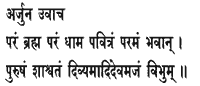
Arjuna said: Thou art the supreme Brahman, the supreme Abode, the supreme Purity, the one permanent, the divine Purusha, the original Godhead, the Unborn, the all-pervading Lord.
The Lord of the Sacrifice
Sri Aurobindo
WE HAVE, before we can proceed further, to gather up all that has been said in its main principles. The whole of the Gita’s gospel of works rests upon its idea of sacrifice and contains in fact the eternal connecting truth of God and the world and works. The human mind seizes ordinarily only fragmentary notions and standpoints of a manysided eternal truth of existence and builds upon them its various theories of life and ethics and religion, stressing this or that sign or appearance, but to some entirety of it it must always tend to reawaken whenever it returns in an age of large enlightenment to any entire and synthetic relation of its world-knowledge with its God-knowledge and self-knowledge. The gospel of the Gita reposes upon this fundamental Vedantic truth that all being is the one Brahman and all existence the wheel of Brahman, a divine movement opening out from God and returning to God. All is the expressive activity of Nature and Nature a power of the Divine which works out the consciousness and will of the divine Soul master of her works and inhabitant of her forms. It is for his satisfaction that she descends into the absorption of the forms of things and the works of life and mind and returns again through mind and self-knowledge to the conscious possession of the Soul that dwells within her. There is first an involving of self and all it is or means in an evolution of phenomena; there is afterwards an evolution of self, a revelation of all it is and means, all that is hidden and yet suggested by the phenomenal creation. This cycle of Nature could not be what it is but for the Purusha assuming and maintaining simultaneously three eternal poises each of which is necessary to the totality of this action. It must manifest itself in the mutable, and there we see it as the finite, the many, all existences, sarvabhu¯ ta¯ni. It appears to us as the finite personality of these million creatures with their infinite diversities and various relations and it appears to us behind these as the soul and force of the action of the gods, —that is to say, the cosmic powers and qualities of the Divine which preside over the workings of the life of the universe and constitute to our perception different universal forms of the one Existence, or, it may be, various self-statements of personality of the one supreme Person. Then, secret behind and within all forms and existences, we perceive too an immutable, an infinite, a timeless, an impersonal, a one unchanging spirit of existence, an indivisible Self of all that is, in which all these many find themselves to be really one. And therefore by returning to that the active, finite personality of the individual being discovers that it can release itself into a silent largeness of universality and the peace and poise of an immutable and unattached unity with all that proceeds from and is supported by this indivisible Infinite. Or even he may escape into it from individual existence. But the highest secret of all, uttamam˙ rahasyam, is the Purushottama. This is the supreme Divine, God, who possesses both the infinite and the finite and in whom the personal and the impersonal, the one Self and the many existences, being and becoming, the world-action and the supracosmic peace, pravr.tti and nivr.tti, meet, are united, are possessed together and in each other. In God all things find their secret truth and their absolute reconciliation. All truth of works must depend upon the truth of being. All active existence must be in its inmost reality a sacrifice of works offered by Prakriti to Purusha, Nature offering to the supreme and infinite Soul the desire of the multiple finite Soul within her. Life is an altar to which she brings her workings and the fruits of her workings and lays them before whatever aspect of the Divinity the consciousness in her has reached for whatever result of the sacrifice the desire of the living soul can seize on as its immediate or its highest good. According to the grade of consciousness and being which the soul has reached in Nature, will be the Divinity it worships, the delight which it seeks and the hope for which it sacrifices. And in the movement of the mutable Purusha in Nature all is and must be interchange; for existence is one and its divisions must found themselves on some law of mutual dependence, each growing by each and living by all. Where sacrifice is not willingly given, Nature exacts it by force, she satisfies the law of her living. A mutual giving and receiving is the law of Life without which it cannot for one moment endure, and this fact is the stamp of the divine creative Will on the world it has manifested in its being, the proof that with sacrifice as their eternal companion the Lord of creatures has created all these existences. The universal law of sacrifice is the sign that the world is of God and belongs to God and that life is his dominion and house of worship and not a field for the self-satisfaction of the independent ego; not the fulfilment of the ego,—that is only our crude and obscure beginning,—but the discovery of God, the worship and seeking of the Divine and the Infinite through a constantly enlarging sacrifice culminating in a perfect self-giving founded on a perfect self-knowledge, is that to which the experience of life is at last intended to lead. But the individual being begins with ignorance and persists long in ignorance. Acutely conscious of himself he sees the ego as the cause and whole meaning of life and not the Divine. He sees himself as the doer of works and does not see that all the workings of existence including his own internal and external activities are the workings of one universal Nature and nothing else. He sees himself as the enjoyer of works and imagines that for him all exists and him Nature ought to satisfy and obey his personal will; he does not see that she is not at all concerned with satisfying him or at all careful of his will, but obeys a higher universal will and seeks to satisfy a Godhead who transcends her and her works and creations; his finite being, his will and his satisfactions are hers and not his, and she offers them at every moment as a sacrifice to the Divine of whose purpose in her she makes all this the covert instrumentation. Because of this ignorance whose seal is egoism, the creature ignores the law of sacrifice and seeks to take all he can for himself and gives only what Nature by her internal and external compulsion forces him to give. He can really take nothing except what she allows him to receive as his portion, what the divine Powers within her yield to his desire. The egoistic soul in a world of sacrifice is as if a thief or robber who takes what these Powers bring to him and has no mind to give in return. He misses the true meaning of life and, since he does not use life and works for the enlargement and elevation of his being through sacrifice, he lives in vain. Only when the individual being begins to perceive and acknowledge in his acts the value of the self in others as well as the power and needs of his own ego, begins to perceive universal Nature behind his own workings and through the cosmic godheads gets some glimpse of the One and the Infinite, is he on his way to the transcendence of his limitation by the ego and the discovery of his soul. He begins to discover a law other than that of his desires, to which his desires must be more and more subordinated and subjected; he develops the purely egoistic into the understanding and ethical being. He begins to give more value to the claims of the self in others and less to the claims of his ego; he admits the strife between egoism and altruism and by the increase of his altruistic tendencies he prepares the enlargement of his own consciousness and being. He begins to perceive Nature and divine Powers in Nature to whom he owes sacrifice, adoration, obedience, because it is by them and by their law that the workings both of the mental and the material world are controlled, and he learns that only by increasing their presence and their greatness in his thought and will and life can he himself increase his powers, knowledge, right action and the satisfactions which these things bring to him. Thus he adds the religious and supraphysical to the material and egoistic sense of life and prepares himself to rise through the finite to the Infinite. But this is only a long intermediate stage. It is still subject to the law of desire, to the centrality of all things in the conceptions and needs of his ego and to the control of his being as well as his works by Nature, though it is a regulated and governed desire, a clarified ego and a Nature more and more subtilised and enlightened by the sattwic, the highest natural principle. All this is still within the domain, though the very much enlarged domain, of the mutable, finite and personal. The real self-knowledge and consequently the right way of works lies beyond; for the sacrifice done with knowledge is the highest sacrifice and that alone brings a perfect working. That can only come when he perceives that the self in him and the self in others are one being and this self is something higher than the ego, an infinite, an impersonal, a universal existence in whom all move and have their being,—when he perceives that all the cosmic gods to whom he offers his sacrifice are forms of one infinite Godhead and when again, leaving all his limited and limiting conceptions of that one Godhead, he perceives him to be the supreme and ineffable Deity who is at once the finite and the infinite, the one self and the many, beyond Nature though manifesting himself through Nature, beyond limitation by qualities though formulating the power of his being through infinite quality. This is the Purushottama to whom the sacrifice has to be offered, not for any transient personal fruit of works, but for the soul’s possession of God and in order to live in harmony and union with the Divine. In other words, man’s way to liberation and perfection lies through an increasing impersonality. It is his ancient and constant experience that the more he opens himself to the impersonal and infinite, to that which is pure and high and one and common in all things and beings, the impersonal and infinite in Nature, the impersonal and infinite in life, the impersonal and infinite in his own subjectivity, the less he is bound by his ego and by the circle of the finite, the more he feels a sense of largeness, peace, pure happiness. The pleasure, joy, satisfaction which the finite by itself can give or the ego in its own right attain, is transitory, petty and insecure. To dwell entirely in the ego-sense and its finite conceptions, powers, satisfactions is to find this world for ever full of transience and suffering, anityam asukham; the finite life is always troubled by a certain sense of vanity for this fundamental reason that the finite is not the whole or the highest truth of life; life is not entirely real until it opens into the sense of the infinite. It is for this reason that the Gita opens its gospel of works by insisting on the Brahmic consciousness, the impersonal life, that great object of the discipline of the ancient sages. For the impersonal, the infinite, the One in which all the impermanent, mutable, multiple activity of the world finds above itself its base of permanence, security and peace, is the immobile Self, the Akshara, the Brahman. If we see this, we shall see that to raise one’s consciousness and the poise of one’s being out of limited personality into this infinite and impersonal Brahman is the first spiritual necessity. To see all beings in this one Self is the knowledge which raises the soul out of egoistic ignorance and its works and results; to live in it is to acquire peace and firm spiritual foundation. The way to bring about this great transformation follows a double path; for there is the way of knowledge and there is the way of works, and the Gita combines them in a firm synthesis. The way of knowledge is to turn the understanding, the intelligent will away from its downward absorption in the workings of the mind and the senses and upward to the self, the Purusha or Brahman; it is to make it dwell always on the one idea of the one Self and not in the many-branching conceptions of the mind and many-streaming impulses of desire. Taken by itself this path would seem to lead to the complete renunciation of works, to an immobile passivity and to the severance of the soul from Nature. But in reality such an absolute renunciation, passivity and severance are impossible. Purusha and Prakriti are twin principles of being which cannot be severed, and so long as we remain in Nature, our workings in Nature must continue, even though they may take a different form or rather a different sense from those of the unenlightened soul. The real renunciation—for renunciation, sanny¯asa, there must be—is not the fleeing from works, but the slaying of ego and desire. The way is to abandon attachment to the fruit of works even while doing them, and the way is to recognise Nature as the agent and leave her to do her works and to live in the soul as the witness and sustainer, watching and sustaining her, but not attached either to her actions or their fruits. The ego, the limited and troubled personality is then quieted and merged in the consciousness of the one impersonal Self, while the works of Nature continue to our vision to operate through all these “becomings” or existences who are now seen by us as living and acting and moving, under her impulsion entirely, in this one infinite Being; our own finite existence is seen and felt to be only one of these and its workings are seen and felt to be those of Nature, not of our real self which is the silent, impersonal unity. The ego claimed them as its own doings and therefore we thought them ours; but the ego is now dead and henceforth they are no longer ours, but Nature’s. We have achieved by the slaying of ego impersonality in our being and consciousness; we have achieved by the renunciation of desire impersonality in the works of our nature. We are free not only in inaction, but in action; our liberty does not depend on a physical and temperamental immobility and vacancy, nor do we fall from freedom directly we act. Even in a full current of natural action the impersonal soul in us remains calm, still and free. The liberation given by this perfect impersonality is real, is complete, is indispensable; but is it the last word, the end of the whole matter? All life, all world-existence, we have said, is the sacrifice offered by Nature to the Purusha, the one and secret soul in Nature, in whom all her workings take place; but its real sense is obscured in us by ego, by desire, by our limited, active, multiple personality. We have risen out of ego and desire and limited personality and by impersonality, its great corrective, we have found the impersonal Godhead; we have identified our being with the one self and soul in whom all exist. The sacrifice of works continues, conducted not by ourselves any longer, but by Nature,—Nature operating through the finite part of our being, mind, senses, body,—but in our infinite being. But to whom then is this sacrifice offered and with what object? For the impersonal has no activity and no desires, no object to be gained, no dependence for anything on all this world of creatures; it exists for itself, in its own self-delight, in its own immutable eternal being. We may have to do works without desire as a means in order to reach this impersonal self-existence and selfdelight, but, that movement once executed, the object of works is finished; the sacrifice is no longer needed. Works may even then continue because Nature continues and her activities; but there is no longer any further object in these works. The sole reason for our continuing to act after liberation is purely negative; it is the compulsion of Nature on our finite parts of mind and body. But if that be all, then, first, works may well be whittled down and reduced to a minimum, may be confined to what Nature’s compulsion absolutely will have from our bodies; and secondly, even if there is no reduction to a minimum,—since action does not matter and inaction also is no object,—then the nature of the works also does not matter. Arjuna, once having attained knowledge, may continue to fight out the battle of Kurukshetra, following his old Kshatriya nature, or he may leave it and live the life of the Sannyasin, following his new quietistic impulse. Which of these things he does, becomes quite indifferent; or rather the second is the better way, since it will discourage more quickly the impulses of Nature which still have a hold on his mind owing to past created tendency and, when his body has fallen from him, he will securely depart into the Infinite and Impersonal with no necessity of returning again to the trouble and madness of life in this transient and sorrowful world, anityam asukham imam˙ lokam. If this were so, the Gita would lose all its meaning; for its first and central object would be defeated. But the Gita insists that the nature of the action does matter and that there is a positive sanction for continuance in works, not only that one quite negative and mechanical reason, the objectless compulsion of Nature. There is still, after the ego has been conquered, a divine Lord and enjoyer of the sacrifice, bhokta¯ram˙ yajn˜ atapasa¯m, and there is still an object in the sacrifice. The impersonal Brahman is not the very last word, not the utterly highest secret of our being; for impersonal and personal, finite and infinite turn out to be only two opposite, yet concomitant aspects of a divine Being unlimited by these distinctions who is both these things at once. God is an ever unmanifest Infinite ever self-impelled to manifest himself in the finite; he is the great impersonal Person of whom all personalities are partial appearances; he is the Divine who reveals himself in the human being, the Lord seated in the heart of man. Knowledge teaches us to see all beings in the one impersonal self, for so we are liberated from the separative ego-sense, and then through this delivering impersonality to see them in this God, ¯atmani atho mayi, “in the Self and then in Me.” Our ego, our limiting personalities stand in the way of our recognising the Divine who is in all and in whom all have their being; for, subject to personality, we see only such fragmentary aspects of Him as the finite appearances of things suffer us to seize. We have to arrive at him not through our lower personality, but through the high, infinite and impersonal part of our being, and that we find by becoming this self one in all in whose existence the whole world is comprised. This infinite containing, not excluding all finite appearances, this impersonal admitting, not rejecting all individualities and personalities, this immobile sustaining, pervading, containing, not standing apart from all the movement of Nature, is the clear mirror in which the Divine will revealHis being. Therefore it is to the Impersonal that we have first to attain; through the cosmic deities, through the aspects of the finite alone the perfect knowledge of God cannot be totally obtained. But neither is the silent immobility of the impersonal Self, conceived as shut into itself and divorced from all that it sustains, contains and pervades, the whole allrevealing all-satisfying truth of the Divine. To see that we have to look through its silence to the Purushottama, and he in his divine greatness possesses both the Akshara and the Kshara; he is seated in the immobility, but he manifests himself in the movement and in all the action of cosmic Nature; to him even after liberation the sacrifice of works in Nature continues to be offered. The real goal of the Yoga is then a living and self-completing union with the divine Purushottama and is not merely a selfextinguishing immergence in the impersonal Being. To raise our whole existence to the Divine Being, to dwell in him (mayyeva nivasis.yasi), to be at one with him, unify our consciousness with his, to make our fragmentary nature a reflection of his perfect nature, to be inspired in our thought and sense wholly by the divine knowledge, to be moved in will and action utterly and faultlessly by the divine will, to lose desire in his love and delight, is man’s perfection; it is that which the Gita describes as the highest secret. It is the true goal and the last sense of human living and the highest step in our progressive sacrifice of works. For he remains to the end the master of works and the soul of sacrifice.
Sri Aurobindo
 About Us | ©1999 - 2009 searchforlight.org
All extracts and quotations from the written works of Sri Aurobindo and the Mother and the Photographs of
the Mother and Sri Aurobindo are copyright Sri Aurobindo Ashram Trust, Pondicherry -605002 India.